CELEBRATION 001 Research draft
Les Falles de València
Also known as Las Fallas de València
A study of ephemeral architecture, public satire and the annual poster as a cultural lens into València’s changing visual identity.
Key facts
- Geography
- València and surrounding communities
- Recurrence
- Annual · March
- Duration
- Nineteen days · five-day culmination
- Type
- Urban celebration · fire ritual · public art
- Spatial scale
- Distributed citywide
- Main rituals
- Despertà · Plantà · Ofrenda · Cremà
- Built structures
- Fallas · children’s fallas
- Objects and media
- Ninots · posters · pyrotechnic apparatus
- Transformation
- Assembly · display · burning
01 / EDITORIAL ESSAY
Las Fallas de Valencia: Ephemeral Design as a Cultural Lens
Essay opening
The role and design of ephemeral architecture in the context of festivals can be explored through an exploration into the annual celebration of Las Fallas in Valencia, Spain. Though its earliest documentation is from the late 1700’s, the original roots of Las Fallas festival in Valencia date back to the 15th century. As spring approached, carpenters would burn their wood scraps and candlesticks that had lit their workshops during the dark of winter. This assemblage and burning gradually became increasingly satirical, as the materials were assembled to resemble political and social figures before burning. This practice evolved into what is now the Fallas Festival, celebrating both the coming of spring and the patron saint of carpentry, San Jose.1 Though the major instance of the festival occurs annually in Valencia, similar festivities have also been adopted by other cities in Spain, as well as other countries such as Argentina.
The festivities of Las Fallas span throughout the first 19 days of March, leading up to the beginning of spring and the vernal equinox which happens on March 19th, 20th, or 21st. The first fifteen days of the month involve mainly preparations and mascletà (fireworks displays), while the 15th to the 19th are the major days of the festival when the majority of festivities occur. Throughout the entirety of the festival, all of the senses are engaged as marching bands, bullfights, and street food occur on a consistent basis.2
The festival follows a rigid schedule of events, beginning with a daily wake up call known as La Despertà. March 15th consists of La Crida, the opening night, followed on the 16th by La Plantà, the installation and competition of the artistic structures called las fallas. March 17th and 18th are the days of Ofrenda de Flores de Fallas, as the statue of the Virgen de los Desamparados is populated with flowers as an offering in the Plaza de la Virgen. This practice is carried out by thousands of falleros and falleras, men and women of the festival, who parade the flowers to the patron saint of Valencia.3 The night of the 18th features the grandest fireworks display of the festival, known as Nit del Foc, followed the next night by the Cavalcada del Foc, a parade of light, music, dancing, and fire.4 The festival concludes with La Cremà, the ceremonial burning of the fallas. The children’s fallas burn at 20:00, followed by the children's first prize winner, and then the children's falla in the Plaza del Ayuntamiento (City Hall Square). Then, the burning of the main fallas begins at 22:00, followed by the first place winner, and the main falla at the Plaza del Ayuntamiento, which burns at 23:00 and closes out the festival.5
01
People, Power Dynamics, and Crowd
The power dynamics of Las Fallas festival are complex as the festivities are largely for the people, by the people, and against the establishment, despite the government playing a role. The history of the festival is such that the building and burning of las fallas is a satirical and creative outlet for artists and civilians to display public commentary on politics and society. However, the main attraction of the festival and most major falla is located at the City Hall Plaza, Plaza del Ayuntamiento, and is government funded.6 Additionally, though the festival had evolved to value experimental and progressive practices, the political climates of Spain over time have left a lasting impression. Researchers Díaz-Solano, Rius-Ulldemolins, and Gisbert-Gracia explain that the “Sexist representation of Franco’s regime is persisting in the traditionalist understanding of the festival.”7 This clash between tradition and evolution is a pattern throughout much of Las Fallas de Valencia.
In a similar capacity, the festival is both a unifying and divisive time for locals of Valencia. On the one hand, the celebratory aspect of the festival brings people together as they assemble as a unit to watch the spectacle of each day’s event. Each neighborhood also leads the commissioning and building its own fallas, demanding a degree of geographical unity and teamwork. The neighborhood committees that are in charge of the fallas are called casals, and serve as a gathering place for falleros and falleras to socialize.8 However, many residents of the Valencian city center have expressed their frustration with the festivities impeding their daily life. According to researchers and local forums, the constant fireworks, explosions, and music throughout each day and night makes it difficult for locals to sleep, specifically those with young children. Locals also note that the culture of satire and overconsumption that the festival promotes results in acts of obscenity and aggression.9 This, in combination with the high densities of tourists that come to see the spectacle of the festival, has pushed many residents away from a sense of unity, and even caused them to leave the area during the duration of the festival.
02
Ephemeral Devices
The entirety of Las Fallas de Valencia is based on ephemeral devices of varying temporality and scale. The most evident of which and largest in scale are Las Fallas, the intricately designed sculptural structures that are built by each neighborhood casal, and burned at the end of the festival. There are approximately 400 casals throughout Valencia that each produce one children’s falla and one full scale falla for the festival.10 The casals are responsible for funding their fallas through fundraisers throughout the year, and picking a theme for their falla. They then commission a team of artists to develop the sculptures.
Usually, this team will include a 2D artist that creates an illustration of the falla and a 3D artist that translates the illustration into a physical sculpture. Though this process used to occur entirely by hand, digital software such as ZBrush and 3D printing technology are widely used by contemporary fallas artists.11 The physical fallas are assembled offsite in large warehouses in the Ciudad del Artista Fallero until the day of La Plantà.12
Falla design continues to live in the balance between design tradition and experimental art. On the one hand, many artists maintain the traditionalist image of fallas, aesthetically resembling animation and often depicting hypersexualized representations of women. More progressive artists are straying from the traditional falla design, introducing new design styles and abandoning the hypersexualization common in past designs. However, newer fallas that tackle issues of sustainability, female empowerment, and diversity are often overlooked for awards and vandalized while on display, highlighting the cultural clash of values revealed by the festival.13
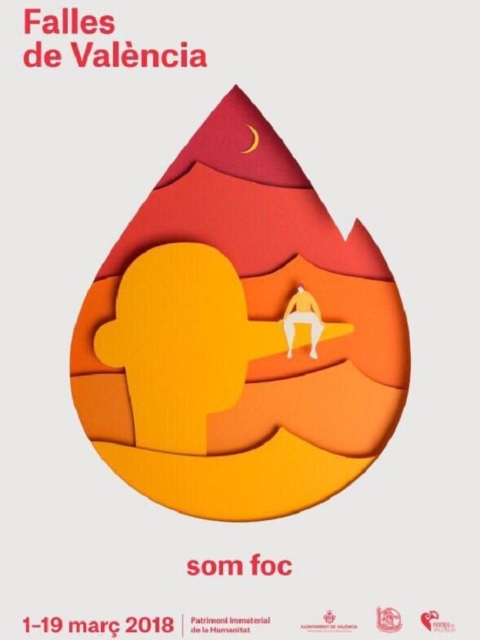
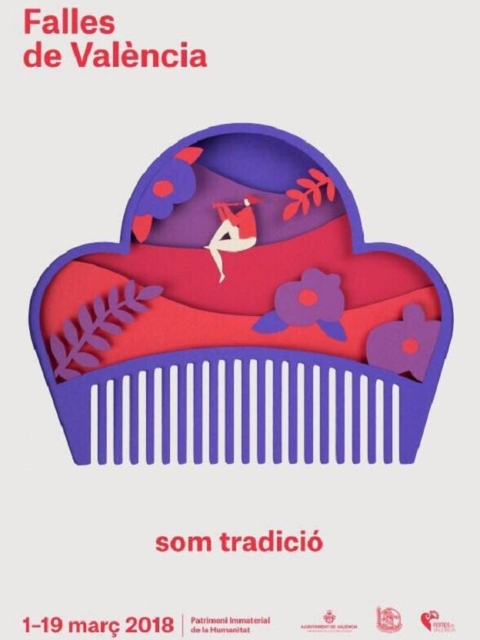
In addition, a poster has been created for the advertisement and immortalization of the festival each year, resulting in yet another ephemeral device. The poster concept was introduced to the festival in the form of a design competition in 1929, and the first poster was designed by competition winner Josep Segrelles Albert. During the time that designer was chosen by competition, submissions grew each year to include dozens of designs from artists across Spain. Each year, along with the first place prize, many other prizes and honors would be given to competitors, including professionals and students alike. The competition jury in its most recent years would include a Fallero Artist, Fallera Mayor of Valencia, a member of the Central Fallera Board, as well as a few artists and designers.14 In 2016, however, the decision was made to switch from a competition to a commission based selection process for the poster designer to ensure adequate pay to artists and a high quality output of design. Though this shift away from the competition model is seen as a step in the right direction by designers, some say there is still room for improvement. Luis Demano, co-creator of the 2017 Las Fallas poster, explains that “the social perception of our professional work sadly depends on the monetary value of our work. Consequently, the current starting price of the competition does not reflect the real dimension of the total volume of work involved in the commission”.15 Now, the selection committee is formed of members of several local design associations including the Association of Designers of the Valencian Community, along with a member of the Central fallera Board and past commissioned poster designers.16 Artist Ibán Ramón was the first to be commissioned to design for the festival in 2016, and pioneered the process even further by being the first to submit a cohesive set of designs instead of just one.
03
Function of the Poster
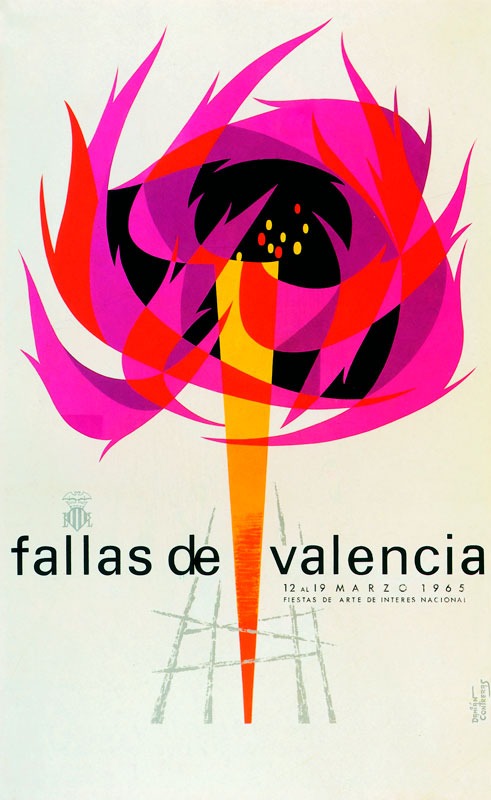
Over the course of the nearly 100 years that the poster has played a role in the Las Fallas, it has consistently served as a lens into the political and social climate of both the festival and of the region as a whole. For example, posters by artist Santiago Carrilero Abad, who was known to develop propagandistic war posters during the Spanish Civil War, can be seen to have the institutional, constructivist aesthetics of war era design.17 This set of aesthetics continued into the 1940s and 1950s under the regime of Francisco Franco, which had a distinct color palette of the red, yellow, and black of the Spanish flag. The posters of the 1970’s, in correlation with the rise of psychedelia and counter-culture movements across the globe, break from past design patterns by taking on a distinctly abstract appearance and incorporating pinks and purples for the first time.18 The subjects of the posters take on an animated appearance in the 1990’s along with the rise of Pixar films in the United States, before eventually in the late 2010’s shifting to the minimalist aesthetics of contemporary brand design.
In a similar way to fallas artists using the festival to experiment with design, the poster artists have used their platform for innovative expression as well. Several artists have taken radical approaches to their designs, notably Damián Contreras Ortiz in his 1965 piece.19 This piece differs dramatically from those that preceded it in both style and color, as it introduces a white background, pink and purple hues, and an abstracted visualization of fire for the first time. The 2013 piece by Fernando Foix takes similar design risks by straying from the style of past years and starting the focus on a single central subject that has continued throughout the decade since. The designers of the annual posters have also intentionally tackled pressing current issues in their work, especially those since the shift to a commission model in 2016. In their 2023 poster, Estudio Democràcia addressed the role of women in Las Fallas, a conversation that is being had in both the realms of fallas and poster design. In contrast to past posters that often feature a fallera’s profile looking downwards, Estudio Democràcia depicts a fallera looking upwards with an expression of power, as a protagonist of the festival.20
Through an investigation into the strategies of temporary design employed at the celebration of Las Fallas, it is evident that annually recurring design provides a platform for both creative experimentation and cultural commentary. The designs of the fallas and posters themselves express an attitude towards the circumstances in which they were created. However, the response to designs that push traditional boundaries by the public and institutions that preside over the festival provide an equally significant view into the public’s capacity to be receptive to shifts in their city’s visual or graphic identity.
Notes
- 1
Sanz Caballero, Natacha. “LAS FALLAS, Valencia’s Spring Festival.” MAMA ÍA. Accessed January 20, 2025.
Full reference↩ - 2
Sanz Caballero, Natacha.
Full reference↩ - 3
Valencia. “FAQs about València’s Fallas | Visit Valencia.” Accessed January 20, 2025.
Full reference↩ - 4
Harsh, Luca. “Las Fallas: The Ultimate Guide to Valencia’s Festival of Fire - Rosetta Stone.” Rosetta Stone, December 14, 2023.
Full reference↩ - 5
Valencia. “FAQs about València’s Fallas | Visit Valencia.”
Full reference↩ - 6
Harsh, Luca.
Full reference↩ - 7
Díaz-Solano, Pau, Joaquim Rius-Ulldemolins, and Verònica Gisbert-Gracia. “La Representación Del Cuerpo De Las Mujeres En Disputa. Feminismo Y Contrafeminismo En Las Fallas De València.” Asparkía. Investigació Feminista, no. 44 (January 1, 2024): 1–36.
Full reference↩ - 8
Sanz Caballero, Natacha.
Full reference↩ - 9
Díaz-Solano, Pau, Joaquim Rius-Ulldemolins, and Verònica Gisbert-Gracia. 1–36.
Full reference↩ - 10
Sanz Caballero, Natacha.
Full reference↩ - 11
Baker, Logan. “Creating Towering Sculptures for Spain’s Las Fallas Festival.” Maxon, January 3, 2024.
Full reference↩ - 12
Valencia. “FAQs about València’s Fallas | Visit Valencia.”
Full reference↩ - 13
Díaz-Solano, Pau, Joaquim Rius-Ulldemolins, and Verònica Gisbert-Gracia. 1–36.
Full reference↩ - 14
Fontán, Julio. “‘Flama’ Cartel Oficial Para Las Fallas de 2011.” Actualidad Fallera, November 30, 2010.
Full reference↩ - 15
Garsán, Carlos. “Ibán Ramón, Luis Demano Y Yinsen al Aparato: Fallas Y Diseño Según Sus Protagonistas.” Valencia Plaza, February 19, 2018.
Full reference↩ - 16
Valencia Plaza. “Así Es La Imagen de Las Fallas 2019 de Dani Nebot,” January 21, 2019.
Full reference↩ - 17
Gómez Aguilella, María José, and Ricard Ramon. “Communicating Territorial Identity through Institutional Posters. Analysis Applied to the Valencian Case.” EFÍMERE 1, no. 1 (April 29, 2024): 143–57.
Full reference↩ - 18
Bellver, Elena. “Historia de Los Carteles de Fallas de Valencia.” okdiario, February 6, 2017.
Full reference↩ - 19
Gómez Aguilella, María José, and Ricard Ramon. 143–57.
Full reference↩ - 20
Tortosa, Javi, and Marta Tortosa. “Offering to Femininity.” Estudio Democracia, 2023.
Full reference↩
02 / CELEBRATION RECORD
Spatial, Material and Ritual Record
The essay interprets the celebration. This record makes its spatial, material and ritual logic comparable across the archive.
01Place and geography
- Country / region
- Spain · Comunitat Valenciana
- Primary city
- València
- Spatial settings
- Streets · squares · neighbourhood districts
- Permanent places
- Casals fallers · Plaza del Ayuntamiento · Plaza de la Virgen · Ciudad del Artista Fallero
- Distribution
- Polycentric · approximately 400 local commissions
02Time and recurrence
- Rule
- Annual · 1–19 March
- Major phase
- 15–19 March
- Preparation
- Year-round fundraising and production
- Culmination
- La Cremà · 19 March
03Organisations and participants
- Organising bodies
- Neighbourhood fallas commissions · comissions falleres
- Community places
- Casals fallers associated with each commission
- Makers
- Fallas artists · two- and three-dimensional specialists · workshops
- Participants
- Falleros · falleras · residents · visitors
- Institutions
- Junta Central Fallera · City of València
04Ritual actions
- Daily action
- La Despertà · mascletà
- Assembly
- La Plantà
- Offering
- Ofrenda de Flores
- Fire sequence
- Nit del Foc · Cavalcada del Foc · La Cremà
05Built structures
- Temporary built structures
- Fallas · children’s fallas
- Fabrication setting
- Workshops and warehouses in the Ciudad del Artista Fallero
- Installation setting
- Streets and squares throughout València
- Mobility
- Fabricated offsite · transported · assembled in place
06Objects, media and apparatus
- Objects and figures
- Ninots as constituent sculptural figures
- Floral apparatus
- Virgen de los Desamparados offering structure
- Graphic media
- Annual institutional poster
- Pyrotechnic apparatus
- Fireworks · firecrackers · mascletà
07Materials and techniques
- Fallas
- Wood · papier-mâché · cardboard · plaster · paint
- Contemporary fabrication
- Expanded polystyrene · digital modelling · 3D printing
- Dress / offering
- Silk · lace · flowers
- Fire / graphics
- Gunpowder · pyrotechnics · paper
08Transformation and research status
- Process
- Design → fabrication → installation → burning
- Material end state
- Combustion · ash · removal
- Recurring afterlife
- Documentation · memory · next annual cycle
- Research corpus
- 104 research objects across essay, methodology, research outputs, annual posters, reference text and material study
- Media rights
- Pending review
- Editorial status
- Research draft · not approved for publication
03 / VISUAL ARCHIVE
Research outputs and poster archive
The complete visual research package: seven original studies and every annual poster image supplied with the catalogue. Select an item to view its record.
7 research outputs
Research outputs
Contemporary drawings, maps, timelines, collages and a physical model produced through the Las Fallas research.
93 archive items
Annual poster archive · 1929–2025
All annual poster images supplied with the research package. No source image was supplied for 1992 or 1937–1939.
Showing 24 of 93 matching items
2025 · Official festival poster
Falles
Miguel Martí and Sergio Membrillas
2024 · Official festival poster
Falles
Javier Juárez and Silvia Casanova (Juárez Casanova)
2023 · Official festival poster
Falles
Democràcia studio
2022 · Official festival poster
Falles
Estudio Menta
2021 · Official festival poster
Falles de València
Fase Studio
2020 · Official festival poster
Falles
Dídac Ballester
2019 · Official festival poster
Falles 2019 València
Dani Nebot
2018 · Official festival poster
Falles 2018
María Pradera and Lorena Sayavera (Estudio Yinsen)
2017 · Official festival poster
Falles de València 2017
Luis Demano and Joan Quirós
2016 · Official festival poster
Falles de València
Ibán Ramón
2015 · Official festival poster
Falles de València 2015
Vicent Ramón Pascual
2014 · Official festival poster
Falles de València 2014
Rafael Vilches Saéz
2013 · Official festival poster
Falles de València 2013
Fernando Foix
2012 · Official festival poster
Falles de València 2012
Vicente Miquel Muñoz
2011 · Official festival poster
Falles de València 2011
Rafael Vilches Saéz
2010 · Official festival poster
Falles de València 2010
Rafael Vilches Saéz
2009 · Official festival poster
Falles de València 2009
Sonia Montalt
2008 · Official festival poster
Falles de València 2008
Borja Bonaque
2007 · Official festival poster
Falles de València 2007
Unknown
2006 · Official festival poster
Falles de Valencia 2006
Rafael Vilches Saéz
2005 · Official festival poster
Falles de Valencia 2005
Morixa Gallart Fous
2004 · Official festival poster
Falles de Valencia 2004
Martin Forès
2003 · Official festival poster
Falles de Valencia 2003
Martin Forès
2002 · Official festival poster
Falles de Valencia 2002
Domènec Morera
05 / SOURCES & CREDITS
Research trail
- Baker, LoganCreating Towering Sculptures for Spain’s Las Fallas Festival ->Maxon · 3 January 2024
- Bellver, ElenaHistoria de Los Carteles de Fallas de Valencia ->okdiario · 6 February 2017
- Fontán, Julio‘Flama’ Cartel Oficial Para Las Fallas de 2011 ->Actualidad Fallera · 30 November 2010
- Díaz-Solano, Pau; Rius-Ulldemolins, Joaquim; Gisbert-Gracia, VerònicaLa Representación Del Cuerpo De Las Mujeres En Disputa. Feminismo Y Contrafeminismo En Las Fallas De València ->Asparkía. Investigació Feminista 44 · 2024 · pp. 1–36
- Garsán, CarlosIbán Ramón, Luis Demano Y Yinsen al Aparato: Fallas Y Diseño Según Sus Protagonistas ->Valencia Plaza · 19 February 2018
- Gómez Aguilella, María José; Ramon, RicardCommunicating Territorial Identity through Institutional Posters. Analysis Applied to the Valencian Case ->EFÍMERE 1(1) · 2024 · pp. 143–157
- Harsh, LucaLas Fallas: The Ultimate Guide to Valencia’s Festival of Fire - Rosetta Stone ->Rosetta Stone · 14 December 2023
- Tortosa, Javi; Tortosa, MartaOffering to Femininity ->Estudio Democràcia · 2023
- Sanz Caballero, NatachaLAS FALLAS, Valencia’s Spring Festival ->MAMA ÍA · accessed 20 January 2025
- Valencia PlazaAsí Es La Imagen de Las Fallas 2019 de Dani Nebot ->21 January 2019
- ValenciaFAQs about València’s Fallas | Visit Valencia ->Accessed 20 January 2025
Methodology / author position
This set of archival research stems from the analysis of the fallas and posters of the Las Fallas Festival as ephemeral design objects and cultural tools. Although there are multitudes of further layers of the festival that could be studied, the scope of this research is limited to its major design devices.
As someone who is not of Spanish origin and has not attended the celebration of Las Fallas, there may be inherent biases in my perspective. My understanding and analysis of this festival is shaped by first and secondary sources, including peer reviewed articles and books, documentaries, and accounts from those who have participated in or observed the events. Every effort has been taken to access reliable sources, and maintain an objective reading of the celebration.
Image rights
The supplied research outputs by Maureen Ferguson are published with the author’s permission. Rights for annual posters and other third-party materials remain pending review.
- Essay date
- Research essay · 2024
- Latest revision
- Website draft · 28 July 2026